 The Promise and Peril of Artificial Intelligence and Sacred Texts with professor Brent Seales of the University of Kentucky
was presented at Upper House on December 7, 2023.

______
The Promise and Peril of Artificial Intelligence and Sacred Texts with professor Brent Seales of the University of Kentucky
was presented at Upper House on December 7, 2023.
Dr. Seales has spent more than two decades restoring cultural and historical artifacts, developing a way to digitally reconstruct fragile documents through a “virtual unwrapping technique.” His most renowned project revealed the book of Leviticus, part of the oldest Hebrew Bible ever found after the Dead Sea scrolls, and the subject of his 2017 Madison lecture.
Dr. Seales showed how he is applying methods inspired by Artificial Intelligence (AI) to rescue and reveal more long-hidden, ancient texts. He addressed the current state-of-the-art in making lost texts unlost, the renaissance unfolding in the fields of papyrology and the classics, as well as implications for biblical manuscript studies. He also discussed the potential pitfalls of AI-based methods, which have the power to interpolate, postulate, and even invent very plausible results that are completely false.
Brent Seales is the Gill Professor and Chair of the Computer Science Department at University of Kentucky, as well as Principal Investigator for the Digital Restoration Initiative, funded in part by a major grant from the Andrew W. Mellon Foundation. He earned both his Ph.D. and M.S. degrees from the University of Wisconsin and a B.S. from the University of Southwestern Louisiana; his areas of specialization are digital imaging and cultural heritage. As a result of his innovations, Dr. Seales has gained a reputation among collectors and curators across the globe as “the guy who can read the unreadable.”

 Jodi Magness presented More than Just Mosaics: The Ancient Synagogue at Huqoq in Israel's Galilee, at Upper House on October 23, 2021.
From 2011-2023 Professor Jodi Magness of the University of North Carolina has been directing excavations in the ancient village of Huqoq in Israel's Galilee. The excavations have brought to light the remains of a monumental Late Roman (fifth century) synagogue building paved with stunning and unique mosaics, including biblical scenes and the first non-biblical story ever discovered decorating an ancient synagogue.
For more information visit www.huqoq.org.

October 19, 2019
The Synagogue in the New Testament: A New Frontier in Biblical Archeology presented by Jordan Ryan, Assistant Professor of New Testament at Wheaton College, Wheaton, Illinois.
What role did synagogues play in the Gospel narrative of Jesus' life and ministry? Dr. Ryan has sought to open new avenues for interpretation and understanding of who Jesus was, as well as what he taught and how he lived, through a better understanding of one of the primary settings of Jesus' activities during his ministry: the synagogue. Read more about Dr. Ryan's presentation on the Archaeological Institute of America's IAD Blog.

October 20, 2018
”Real People of the Bible - What Archaeology Tells Us About David and more than 50 Other Biblical Characters” presented by University of Wisconsin alumnus Lawrence Mykytiuk, Purdue University.Lawrence Mykytiuk is Associate Professor of Library Science and has a courtesy appointment as Associate Professor of History at Purdue University. He holds a Ph.D. in Hebrew and Semitic Studies from the University of Wisconsin and is the author of the book Identifying Biblical Persons in Northwest Semitic Inscriptions of 1200–539 B.C.E. (Society of Biblical Literature, 2004) and a related article, “Corrections and Updates . . .” in Maarav (2009).
Professor Mykytiuk's 2014 Biblical Archaeology Review article, Archaeology Confirms 50 Real People in the Bible, pushed the list to even more figures from the Hebrew Bible who have been confirmed archaeologically through his careful analysis. But that wasn't the end of it. "All told," he reported, "counting both published and unpublished results, I find 55 people in the Hebrew Bible and 30 in the New Testament whose historical existence stands documented in writings from their times."
 April 15, 2018
Ten Seasons at Tel Gezer: Results of the Tandy Museum Excavation Project presented by Sam Wolff, a senior archaeologist with the Israel Antiquities Authority and co-director of the Gezer Iron-Age Gate excavation. Sam earned his Ph.D. in Hebrew from the University of Wisconsin and has spoken before our Society several times previously.
Sam first volunteered at Tel Gezer as a UW student in 1972 and 1973. After receiving his PhD and excavating numerous sites in Israel, he was invited to be co-director of a new excavation at Gezer in 2006.
They excavated 13 levels of occupation, with a number of destructions layers that testified to its border status. Gezer peaked as a city in the Middle Bronze Age. One of Gezer's rarities is a city wall in the early Iron Age period.
________
Our 50-Year Anniversary Celebration

Madison Biblical Archaeology Society celebrated our 50 year anniversary on October 20, 2017.
University of Wisconsin alumnus Brent Seales presented "Digital Unwrapping: Homer, Herculaneum, and the Scroll from En-Gedi," highlighting his ground-breaking research that is allowing modern scholars to access carbonized ancient texts that have been previously unreadable. Professor Seales earned his PhD in computer science at the University of Wisconsin in 1992 and is currently chair of the computer science department at the University of Kentucky.
Professor Seales has developed a software program that digitally unwraps ancient scrolls that have burned to a crisp and are otherwise unreadable. His program successfully analyzed a computerized tomography scan (CT-scan) of a 2,000-year old scroll recovered from the 1970 excavation of a burned synagogue at En Gedi, an oasis on the shore of the Dead Sea in Israel. When the scroll was finally readable, it turned out to be the biblical book of Leviticus. He is also working on virtually unrolling carbonized scrolls recovered from the Villa of the Papyri at Herculaneum, burned but not destroyed by the eruption of Mt. Vesuvius in 79 A.D. Professor Seales' research was subsequently featured on 60 Minutes.
“Brent Seales has made a career of unlocking lost secrets. With specialized software he and his team developed, the University of Kentucky computer scientist can read ancient scrolls too fragile to unroll.”
- Discover magazine, May 2017
“Brent Seales has unlocked the text in the early Leviticus scroll from En Gedi — the oldest Pentateuchal scroll in Hebrew outside of the Dead Sea Scrolls.”
- Sci-News.com, September 2016
The lecture was presented at Upper House, on the University of Wisconsin campus, co-sponsored by the Stephen and Laurel Brown Foundation, with additional support from InterVarsity Christian Fellowship and allgodspeople.com, and also in celebration of International Archaeology Day, October 21, 2017.
________

December 3, 2017
MBAS president Jeff Blakely gave a report on The Imperial Egyptian Presence in Southern Palestine in the 14th through 12th centuries BCE. This added new information to our understanding of this Canaanite period in the history of southern Palestine, when the Amarna tablets clearly reflect Egyptian hegemony. The presentation also included a brief update on the Tel el-Hesi regional project, with which he has been associated for most of the past half century.
________

May 7, 2017
Sidnie White Crawford, professor of Classics and Religious Studies at the University of Nebraska, spoke on The Qumran Scrolls As A Scribal Collection
Sidnie White Crawford has spoken before the society previously on her internationally recognized Dead Sea Scroll research; her topic in 2001 was "Not According to Rule: Women, the Dead Sea Scrolls and Qumran." This time she took a broader view of Dead Sea Scroll research and with some references to her latest project which argues that Qumran served as a library and scribal center in competition with the Temple in Jerusalem, and that the manuscripts found in the eleven caves at Qumran are the remnants of that library.
Dr. Crawford currently serves as Chair of the Board of Trustees of the W. F. Albright Institute of Archaeological Research in Jerusalem, the American headquarters for archaeological research in the Holy Land. This was her second lecture before the Madison Biblical Archaeology Society.
________
March 19, 2017
Joel Pless, professor of Theology at Wisconsin Lutheran College, gave a lecture on The People of Pompeii.
Pompeii was an ancient Roman city buried by the eruption of Mount Vesuvius in A.D. 79. It remains to this day one of the most valuable archaeological sites for learning about the daily life and times of a first century Roman city, a city of the New Testament era. Professor Pless described the sequence of events as the volcano erupted and buried the city under volcanic ash. He examined pictures of the plaster casts of the human victims of the Pompeii eruption in their final moments of life.
November 9, 2016: Alice Mandell, Assistant Professor of Classical Hebrew Language and Biblical Literature at the University of Wisconsin, spoke on "'He is a dog!': Complaining Kings in the Amarna Age".
During the reign of Pharaoh Akhenaten (roughly between 1350-1335 BC), the rulers of city states in Canaan sent hundreds of complaints and requests for help on cuneiform tablets to Akhenaten's capital, el-Amarna. The texts offer insight into the culture and language of the Canaanite residents prior to the formation of the Israelite kingdom. The lecture focused on texts, petrology, and archaeology.
October 19, 2016: Bryant Wood, Director of Research for Associates for Biblical Research spoke on "Discovery of the Lost Fortress of Ai".
In 1995 a dig began at Khirbet el-Maqatir, nine miles northeast of Jerusalem, a small attempt to locate Ai, the city conquered by Joshua and the Israelites following the fall of Jericho. In recent years Khirbet el-Maqatir has been one of the largest digs in Israel in numbers of volunteers. Occupation layers have been identified not only from the time of Joshua but also from the time of Jesus.
Khirbet el-Maqatir may have been the city of Ai, from Joshua 7 & 8. It may also have been the city of Ephraim from John 11:53. In recent years excavators have found remains of a Byzantine monastery, Bronze Age Egyptian scarabs, and more than 1,000 coins from the first century.
February 22, 2015: MBAS president Jeff Blakely gave a sneak preview of the lecture he presented at the British Museum in London before the Anglo-Israel Archaeological Society and the Palestine Exploration Fund, focusing on Tell el-Hesi.
Tell el-Hesi was the first excavation in Ottoman Palestine by western archaeologists 125 years ago, originally identified with biblical Lachish and later Eglon, but now identified with neither. Jeff has been excavating at Hesi since 1971 and is currently co-director of the excavation, which has recently turned its attention to the nearby site of Khirbet Summeily. During the summer of 2014 the Summeily excavation discovered some extremely rare 10th century bullae (clay seal impressions).
November 17, 2014: Geoffrey Ludvik, a graduate student of our president Jeff Blakely, spoke on "Stone Beads in the Ancient Near East: New Insights into Trade and Technology from the Time of Abraham."
September 21, 2014: Lisa Mahoney, professor of the history of art and architecture at DePaul University, presented a program on "The Art and Archaeology of the Crusades." When traveling to Israel, there are biblical sites and there are also sites from other periods which relate to the biblical period. This includes Crusader castles and churches, and other Crusader remains such as the fortifications at Caesarea.
November 3, 2013: Michele Stillinger, of the University of Minnesota's Institute for Rock Magnetism, spoke on Archaeomagnetic Dating of Iron Age Artifacts from Khirbet Summeily. Michele has been working with MBAS president Jeff Blakely on the excavations of Khirbet Summeily, near Tel el-Hesi, and offered a unique perspective on cutting edge technology involving archaeomagnetic dating and archaeology.
October 27, 2013: Gabriel Barkay reported on “New Discoveries in the Archaeology of Jerusalem.”
Dr. Barkay is the director of the Temple Mount Sifting Project, and was the first to translate the "Bethlehem Seal," which the Sifting Project discovered last year in debris excavated from the City of David area of Jerusalem. The seal dates to the 7th century BC, and is the earliest mention of the name of Bethlehem, the city in which Jesus was born. This is one of the many items described in the presentation.
Dr. Barkay is the recipient of the 1996 Jerusalem Prize for Archaeological Research. He has directed a number of excavations, including the Ketef Hinnom excavation which in 1979 discovered two silver amulet scrolls which are inscribed with the earliest biblical inscription. The scrolls, containing the priestly benediction from Numbers 6:24-26, also date to the 7th century B.C. Dr. Barkay teaches at Bar Ilan University in Tel Aviv and has also taught for many years at what is now Jerusalem University College.May 1, 2013: Steven McKenzie delivered the Annual Lecture of the Department of Hebrew and Semitic Studies and the Madison Biblical Archaeology Society, speaking on "My God is YHWH": The Stories of Elijah in the Book of Kings. McKenzie is Professor of Hebrew Bible/Old Testament and Senior Research fellow in the Department of Religious Studies at Rhodes College in Memphis, Tennessee. Professor McKenzie is an internationally recognized scholar on the biblical books that tell the stories of ancient Israel's existence as a state (Samuel, Kings, and Chronicles).
April 14, 2013: MBAS president Jeff Blakely gave the society a Tel el-Hesi update, focusing on the history of agriculture and nomadic populations in the Tel el-Hesi border area between the Shephelah and the Negev.
March 13, 2013: Bela Sandor, Professor emeritus of Engineering at the University of Wisconsin, spoke on "Chariots of Tutankhamun and the Bible." Prof. Sandor, of the UW's Department of Engineering Physics, contributed his research into ancient chariotry to a recent PBS NOVA documentary called "Building Pharaoh's Chariot." A news release calls Sandor, "an international expert on the techno-archaeology of chariots." Sandor himself calls the ancient Egyptian chariots a marvel of engineering. "Their engineering was stupendous," he says. "Modern engineers could not do any better with only wood, leather and glue."
February 24, 2013: Daniel Schowalter, Professor of Religion and Classics at Carthage College in Kenosha, spoke on Echoes of Identity: A New Inscription from Roman Omrit. Omrit is the site of a Roman temple in northern Israel that excavators believe is a temple built for Emperor Augustus by Herod the Great. A newly discovered paving inscription from Omrit offers a terminus ante quem the latest date before which the construction of the third phase of the temple complex took place. The inscription provides additional connections between Omrit, Caesarea Philippi, and nearby Banias, or as the gospels put it, "the region of Caesarea Philippi." The inscription also reveals new details about the socio-economic make-up of the region in the first century CE, and is dedicated to a rather unexpected deity, the nymph Echo.
November 19, 2012
Sam Wolff, a University of Wisconsin graduate and archaeologist with the Israel Antiquities Authority, gave an update on the excavations at Tel Gezer.
Gezer is one of the most important, and most excavated, sites in Israel. Dr. Wolff have a report on the three excavations currently underway at Tel Gezer: the main excavation surrounding the Iron Age gate, the survey excavations which is uncovering new Gezer boundary stones, and the Gezer water system.
Dr. Wolff is co-leading the main excavation surrounding the Iron Age gate, along with Steve Ortiz, of the Southwest Baptist Theological Seminary. He reports that the excavation has recently uncovered a traditional 4-room house and is now nearing the levels that the excavators expect will give them new information on the dating of the Iron Age gate.
November 12, 2012
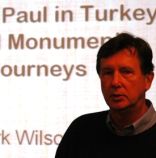
Mark Wilson, Visiting Professor of Early Christianity at Regent University and founder of the Asia Minor Research Center, in Antalya, Turkey, spoke on Trekking with Paul in Turkey: Routes and Monuments of His Journeys"
Prof. Wilson described the two main routes that Paul would likely have taken on his first missionary journey, as well as other routes that he has personally researched. He also reported on the discovery of a first century inscription that can out of one of his trips on an ancient Roman road in Turkey.
October 21, 2012
Andrew Vaughn, Executive Director of ASOR—the American Schools of Oriental Research spoke on "Jerusalem as David and Solomon Knew It"
The Bible describes David and Solomon as ruling over a powerful kingdom, known historically as the United Monarchy. Most historians have assumed that if the kingdom of Israel was strong and expansive, then the capital city (Jerusalem) also would have been a major, expansive city. However, in the past 15 years, several prominent scholars—especially David Ussishkin and Israel Finkelstein—have posited that David and Solomon’s Jerusalem was not a major capital, because it was limited in size to the mound of the City of David. These scholars further argue that David and Solomon were not major kings, but rather were leaders of chiefdoms.
In this presentation, Dr. Vaughn offered another interpretation of the archaeological data and shows that the biblical account of Jerusalem is accurate. David and Solomon ruled over an expansive kingdom, and their capital city (Jerusalem) was a neutral administrative headquarter whose archaeological remains are consistent with the biblical record. He thus demonstrates that the “Jerusalem minimalists” have forced modern concepts of what a capital city should be onto the world of the Bible.
Read more about Andrew Vaughn's presentation in a story at allgodspeople.com.
May 2, 2012
Bernard Levinson, Professor of Classical and Near Eastern Studies, at the University of Minnesota, spoke on 'You Must Not Add Anything to What I Command You': Paradoxes of Canon and Authorship in Ancient Israel
Professor Levinson's lecture addressed how Israel, having a tradition of prestigious or authoritative texts, dealt with the problem of literary and legal innovation. By comparing scribal practices in ancient Mesopotamian cuneiform law, he shows how ancient Israel's development of the idea of divine revelation of law that might have been expected to impede legal revision or amendment tolerated modification through exegetical innovation.

April 15, 2012,
Mark Schuler, Professor of Religion & Theology, Concordia University-St. Paul, reported on Excavations at Hippos/Sussita, a City of the Decapolis. Excavations at Hippos/Sussita have been taking place for twelve years now, and prof. Schuler has been a part of the excavations for all but the first year. He brought us up to date on what has been excavated at this ancient city, with particular attention to the Northeast Church (one of 8 Byzantine-era churches identified so far) where his work has been concentrated.

March 25, 2012
"Qeiyafa and Talpiot Tomb Inscriptions" was presented by Christopher Rollston, Professor of Old Testament and Semitics, Emmanuel School of Religion, on Sunday, March 25, 2012.
Christopher A. Rollston is an epigrapher who was trained at Johns Hopkins University, and was described by MBAS president Jeff Blakely as "the leading epigrapher of our generation." He teaches at Emmanuel Christian Seminary in Johnson City, Tennessee. Chris is editor of MAARAV, A Journal for the Study of the Northwest Semitic Languages and Literatures, and his most recent book is Writing and Literacy in the World of Ancient Israel: Epigraphic Evidence from the Iron Age. He is the epigrapher of the Hesi Regional Project as well as epigrapher for other projects in the region, and was called to testify in the fraudulent antiquities trial before judge Aharon Farkash in Jerusalem.

March 7, 2012
"Examining Judah's Border with Gaza: Excavations at Khirbet Summeily" was the title of MBAS president Jeff Blakely's presentation, as he discussed his latest archaeological research in southern Israel at the site of Khirbet Summeily.
Jeff recalled his first MBAS presentation 35 years ago, when he was first participating in the excavations of Tell el-Hesi. He briefly reviewed the history of the Hesi excavations, his recent survey archaeology in the area, and the decision to excavate a small Iron Age village site nearby Hesi called Khirbet Sumeilly. A more detailed story on Jeff's presentation is at the website allgodspeople.com. The excavations began last summer and will continue in 2012 in cooperation with the Cobb Institute of Archaeology at Mississippi State University.
______

April 27, 2011
Professor John J. Collins presented a lecture, "Shifting Perspectives on the Dead Sea Scrolls."
The consensus about the Dead Sea Scrolls is changing, following recent archaeology at Qumran, as well as the recently completed publication of all of the scrolls. Professor Collins will discuss new perspectives on the idea that the collection was a library, the archaeology of the site, the origin and history of Qumran sect, the role of women in the Scrolls, and the dualistic theology of the sect. Professor Collins is Holmes Professor of Old Testament Criticism and Interpretation at Yale University.
______

April 27, 2010
Daniel M. Master, Associate Professor of Archaeology at Wheaton College, spoke on "All the Merchants are Silenced: Economy at the End of the Kingdom of Judah"
The violent campaign of Sennacherib in the late 8th century BCE changed the southern Levant. In the aftermath, some say the Assyrians created a centralized economy extending from the cosmopolitan port of Ashkelon all the way into the deep recesses of the monastic Judean desert. Others see the seventh century economy as a contribution of the local ways. Kin networks were reformed; agricultural and pastoral production was rebalanced, and life continued on much as it had before.
Daniel M. Master is an Associate Professor of Archaeology at Wheaton College and in 2008-2009 was a National Endowment for the Humanities Fellow at the Albright Institute for Archaeological Research in Jerusalem, Israel. He is the Field Director of the ongoing excavation, the Leon Levy Expedition to Ashkelon and co-editor for the forthcoming final reports: Ashkelon 3, the seventh century BCE and Ashkelon 5, the Iron Period.
March 21, 2010
Professor Lawson Younger spoke on "Aramean Astral Religion in Light of Recent Discoveries."
His lecture provided insight into religious practices in Old Testament times, based on the celestial design of an Aramean brass bowl. Lawson Younger is professor of Old Testament, Semitic Languages, and Ancient Near Eastern History at Trinity Evangelical Divinity School in Deerfield, Illinois. He spoke to the Madison Biblical Archaeology Society in 2003 on the lost tribes of Israel.
February 21, 2010
Professor James Hardin of Mississippi State University, spoke on Absence of Evidence: David's Jerusalem.
Professor Hardin has been involved with the Lahav Research Project's work at Tel Halif in Israel since 1986. He specializes in the Bronze and Iron Age cultures of ancient Syria-Palestine and has been our guest once before, lecturing on "Iron Age Households in Ancient Judah" in 2003.
A report on this meeting was featured on the local news website allgodspeople.com.

The 53rd Annual Lecture, "Ancient Synagogues in the Land of Israel" was presented by Jodi Magness, the Kenan Distinguished Professor for Teaching Excellence in Early Judaism at the University of North Carolina, Chapel Hill, on April 28, 2009.
More than 100 synagogue buildings, dating from the first to seventh centuries C.E., have been discovered in ancient Palestine. Professor Magness surveyed these buildings, focusing especially on the surprising pagan motifs that decorate some of them, and considered such questions as where and when the institution of the synagogue originated. The lecture brought together archaeology, art history, and religious studies in a study of a central institution of Judaism with important ramifications for early Christianity. A story on the lecture is at www.allgodspeople.com.
==> April 7, 2009: MBAS president Jeff Blakely spoke on "Generating a Regional Understanding through Survey: The Tell el-Hesi Survey," presenting information on his latest survey work at the site of Tell el-Hesi in Israel. Following 30 years of excavation and study, the archaeological survey of the surrounding region is one of the final aspects of the project.
==> March 1, 2009: Dr. Walter Kaiser spoke on "Major Archaeological Finds of the Biblical Periods."" Dr. Kaiser is President Emeritus and Distinguished Professor of Old Testament and Ethics at Gordon-Conwell Theological Seminary, and the General Editor of The NIV Archaeological Study Bible.
Dr. Kaiser's lecture is available as an MP3 file for listening or downloading here. (Time, approximately 65 minutes.)
Thank you to the following unofficial co-sponsors for their promotional support for this special event: Bethel Lutheran Church, Blackhawk Church, Edgewood College Religious Studies Department, Gateway Community Church, Geneva Campus Church, High Point Church, Hillel-University of Wisconsin, InterVarsity Christian Fellowship, Lake City Church, Lubar Institute for the Study of Abrahamic Religions, Luther Memorial Church, Mad City Church, New College Madison, New Crossing Church, Plymouth UCC Church, The Book and The Spade radio program and WNWC radio.

On Sunday, October 26, 2008, we heard from Timothy Harrison, Professor of Near & Middle Eastern Civilizations at the University of Toronto and the Project Director of the Tell Tayinat Project in Turkey. His talk was entitled, “Sea Peoples, Neo-Hittites and the ‘Land of Palastin’: Recent Investigations at Tell Tayinat on the Plain of Antioch.”
The past few summers have provided a wealth of new archaeological and epigraphic data about the Iron Age in the region of Antioch. At the same time, implications drawn from this work are likely to have an impact on our understanding of the Sea Peoples, their relationship to the Philistines of the Bible, and their arrival in what came to be called the ‘Land of Palastin.’ This was a time of systemic dislocation and disruption, the period of the Judges in the Biblical chronology. Professor Harrison is also the president of the American Schools of Oriental Research.
______

On Tuesday, October 7, 2008, Dr. Katia Cytryn-Silverman of Hebrew University, gave a presentation on "Roads and Road-Inns in Palestine During the Mamluk Period." Dr. Cytryn-Silverman is an expert in medieval khans, or caravansarai, of the Holy Land. These are the road inns in which travelers and Christian pilgrims would have stayed during Ayyubid, Mamluk, and Ottoman times.
She reported that most of the Khans were built during the Mameluke period, 13th-16th centuries, to help connect the royal mail network. They provided an accomodation for travelers, rich and poor, to stay the night. Some khans in Turkey are still well preserved but khans in Israel are largely in ruins. However, several bridges that were built at the same time by the Mamluks are still in operation in Israel. The khans were run as charitable institutions and were established by high ranking Mamluks living in Cairo, or sometimes by rich merchants.
______
On May, 5, 2008, Theodore J. Lewis, the Blum-Ivry Professor of Near Eastern Studies at Johns Hopkins University, presented the 52nd Annual Lecture of the Department of Hebrew and Semitic Studies and the Madison Biblical Archaeology Society. He spoke on “The Effective Power of Words: Incantations in Ancient Israel.” Magical incantations were widespread and important throughout the Ancient Near East and rabbinic Judaism, yet very few are quoted in the Hebrew Bible. In fact, archaeology has uncovered magical paraphernalia and inscriptions that show that magical incantations were indeed part of the life of Israel in biblical times. Careful examination of the Biblical text shows that the fundamental magical concept of effective words can indeed be found in the Bible.
Professor Lewis received his B.A. and M.A. at the University of Wisconsin-Madison and his Ph.D. at Harvard University. His numerous publications on the Bible and the Ancient Near East include Cults of the Dead in Ancient Israel and Ugarit (1989) and the forthcoming Religion of Ancient Israel.
Professor Leonard Greenspoon of Creighton University presented a lecture on November 5th, entitled "Interpreting the Word: Hope, Hype and Habit in 50 years of Biblical Studies." Professor Greenspoon is well known for evaluating the history of scholarship on the Hebrew Bible, and presented an interesting lecture that looked at scholarly contributions as well as newspaper comic strips that presented a Biblical perspective. Professor Greenspoon has published numerous articles on the Septuagint, the history of biblical scholarship, and the role of the Bible in popular culture. This lecture was sponsored by the Department of Hebrew & Semitic Studies and funded by the Lubar Intitute for the Study of Abrahamic Religions.
Professor Ron E. Tappy of Pittsburgh Theological Seminary presented the 51st Annual Lecture of the Society on Wednesday, May 2, 2007. His topic was "The Origins of our Alphabet: New Evidence for the History of Writing in the Tenth Century BCE."

The ancient Canaanite alphabet is the origin of the later Greek and Roman alphabets, but precisely when alphabetic writing began in ancient Israel is hotly debated. The 2005 discovery of the earliest complete alphabet in Israel dating to the 10th century BCE is undoubtedly an extremely important piece of the history of the origins of writing. More importantly, the discovery fuels a heated argument between historians and archaeologists concerning the historicity of biblical accounts of the regions of David and Solomon in the 10th century BCE. "Minimalists" believe that the biblical accounts of David and Solomon are fictional and were composed later because the Israelites at the time were illiterate. The discovery of this inscription in a small village (not an urban center) suggests that not only was writing in use, but that there was, in fact, a centralized state.
Prof. Tappy is the Project Director and Principal Investigator of the Zeitah Excavations in Tel Zayit, Israel. He is also the G. Albert Shoemaker Professor of Bible and Archaeology at Pittsburgh Theological Seminary and the Director of the James L. Kelso Bible Lands Museum. A report on professor Tappy's talk is on allgodspeople.com.
Israeli archaeologist Gabriel Barkay returned to the Madison Biblical Archaeology Society for the first time since 1991 on Wednesday, February 14, 2007 to speak on "Archaeology and the Temple Mount in Jerusalem."

Professor Barkay is one of the world's leading experts on the archaeology and history of Jerusalem, an archaeologist who has dug at a number of sites in Israel, and the winner of the prestigious Jerusalem Prize for Archaeology in 1996. Over the last two years Professor Barkay has been "re-excavating" tons of dirt dug from the Temple Mount and dumped in the Kidron Valley as part of a mosque renovation in November, 1999. Even though the dirt has been removed from its historical context, a number of important discoveries have been made that add to our knowledge of the history of the Temple Mount and Jerusalem. Professor Barkay received his Ph.D. in 1985 Summa Cum Laude from Tel Aviv University, and taught for over 27 years at Tel Aviv University. He is now teaching at Bar Ilan University, Hebrew University, and Jerusalem University College. In 1979, Professor Barkay discovered the Ketef Hinnom silver amulet, which contains the earliest biblical passage (Numbers 6:24-26) found outside of the Bible, and is now on display in the Israel Museum.
A report on professor Barkay's lecture is on allgodspeople.com. The story of this unusual salvage excavation has also been covered extensively by the Associated Press, Biblical Archaeology Review, Christianity Today, and other media.
Professor O’Connor is a professor in the Department of Semitic and Egyptian Languages and Literatures at Catholic University of America, where he teaches courses in Hebrew Bible, Biblical Hebrew, Ugaritic and Akkadian. He is one of the leading scholars of Biblical Hebrew and co-author of the classic reference work, An Introduction to Biblical Hebrew Syntax, now in its ninth printing.
"The Cave of John the Baptist" was presented by archaeologist Egon Lass on Tuesday March 28, 2006. The discovery was first reported in the late summer of 2004, a curious cave near Kibbutz Tzuba, just west of Jerusalem, which was tentatively connected with the ministry of John the Baptist. Shimon Gibson, the director of the project, then published the book, Cave of John the Baptist: The Stunning Archaeological Discovery That Has Redefined Christian History (Doubleday, 2004). The project has continued, and an Iron Age water system was discovered but only briefly mentioned and described by the press.
Egon Lass is one of the senior excavators on this project. He spoke to us just after returning from Israel and the latest season of excavation at the Kibbutz Tzuba cave, providing news directly from the field.
Professor Aaron Burke spoke on “Reconstructing Bronze Age Kingdoms: Archaeological Evidence for the Middle Bronze Age Kingdom of Ashkelon (ca. 1925––1550 BC)” on Wednesday March 16, 2005. Dr. Burke is a 1996 graduate of Wheaton College, and has just been hired as Professor of Archaeology of Ancient Israel and early Judaism at UCLA. This analysis of the Middle Bronze Age in Ashkelon was the topic of his recently completed doctoral dissertation at the University of Chicago and focused on defensive fortifications at smaller nearby cities that were under the influence of Ashkelon. Professor Burke was a part of excavations at Ashkelon from 1997-2000.
MBAS President Jeff Blakely spoke on "The Joint Archaeological Expedition to Tell el-Hesi: Phase III Regional Survey, 2004 Season Field Report."In the summer of 2004 the Hesi Expedition reactivated its regional survey project after a hiatus of over 20 years. It was an interesting experience trying to use old data and join it with newly collected material. The survey project will be back in the field in 2006. This presentation was similar to a report given at the Albright Institute last summer. This meeting was held at Edgewood College, Wednesday April 20, 2005.
Professor Ronald Hendel, the Norma & Sam Dabby Professor of Hebrew Bible at the University of California-Berkeley, spoke on "Dreams of the Golden Age: Prophecy, Poetry, Eschatology" on Wednesday, May 4, 2005. This lecture discussed the birth of eschatology in the relationship between poetic effects, mythic imagery, and intertextuality in the writings of Isaiah.
Our first fall lecture was "The Royal Purple and Biblical Blue: An Interdisciplinary Study" by Professor Ehud Spanier, of the Leon Recanati Institute for Maritime Studies at the University of Haifa, on September 14th. Professor Spanier described the ancient dye industries of the Royal Purple and the Biblical Blue, two of the main dyes of the Biblical world. They were produced from marine snails. Through inter- and multi-disciplinary studies, including marine history, archaeology, and biological aspects as well as chemical, biochemical, religious and cultural facets, the sources of these ancient dyes and the dying process has been studied.
Professor Cynthia Miller of the UW-Madison Department of Hebrew and Semitic Studies, presented an illustrated lecture entitled, "Languages without Speakers: Reconstructing the Languages of the ANE from Epigraphic Fragments" on October 17, 2005 at Edgewood College.
Professor Anson Rainey of Tel Aviv University returned to MBAS on November 15th. Professor Rainey's lecture was "Whence Came the Israelites and Their Language?" Professor Rainey offered new perspectives on the background of the early Israelites, in contrast to the theories that have been presented by other archaeologists and Biblical scholars
Jennifer Westpfahl, a UW-LaCrosse student who has participated in excavations at Megiddo, spoke on Wednesday December 7th on "The Megiddo Excavation: Archaeology and the Bible." "
...The site of Megiddo is widely regarded as one of the most important biblical period sites in Israel. Protected by fortifications and covered with palaces and temples, Megiddo was one of the most important cities in Canaan and Israel. Because of its location and importance, archaeologists have been excavating the site for over one hundred years. Biblical scholars often cite Megiddo as a site containing supporting evidence for the chronology found in biblical text, a subject that has come into controversy in recent times. Israel Finkelstein, current director of excavations at Megiddo and professor at Tel Aviv University, has been excavating at Megiddo for over 10 years and is planning further excavations at the site. According to Finkelstein, his excavations have revealed archaeological evidence that puts the more traditionally held viewpoints on biblical chronology in question. This presentation will cover the history of Megiddo, how the site relates to biblical text, the 2004 excavation and evidence Finkelstein claims supports the Low Chronology argument.
...Megiddo was recently in the news due to the discovery of what appears to be one of the oldest Christian buildings in Israel nearby.
"Did the Bible Know Homer? Goliath's Armor and Israelite Collective Memory" Tuesday, November 30, 2004
Presenter: Professor Azzan Yadin, Assistant Professor of Jewish Studies at Rutgers University. This lecture combined close textual analysis, broad reflections on the nature of cultural memory and transmission, and comparative analysis to discuss two distant yet foundational texts of Western culture whose relation has not yet been fully explored. Prof. Yadin is a prolific and creative scholar who quickly has established himself as a key figure in Jewish studies. Sponsored by: University Lectures Committee, the Department of Hebrew & Semitic Studies, Mosse/Weinstein Center for Jewish Studies, and the Religious Studies Program.
Our annual lecture was held on Wednesday, May 5th, at Grainger Hall. Professor Saul Olyan of Brown University presented a lecture on: "Rites and Rank: Contesting and Defending Priestly and Divine Privilege in Biblical Cultic Settings." The lecture argued that rites create and publicize status relations. Professor Olyan examined biblical texts in which an established hierarchy is challenged in ritual settings by those cast as having an inferior rank.
 On March 25th, Professor Patricia Gerstenblith of the DePaul University Law School, presented a talk entitled, “From Bamiyan to Baghdad: The Crises in Cultural Heritage Preservation at the Beginning of the 21st Century.” President Jeff Blakely said, "Patty is an old Hesi-ite who is a Ph.D. archaeologist besides being a law professor, specializing in international antiquities laws. Over the past few years she has filed briefs in major cases as well as informed the public about antiquities issues."
______
What was officially our February meeting was actually held on Tuesday, March 2nd. MBAS President Jeff Blakely assessed "The Development and Future of Biblical Archaeology." The talk went back to the Biblical research of Edward Robinson, covered the Puritans arrival in the New World and their theological development, and then brought in geographical perspectives (especially those of Alexander von Humboldt), 20th century archaeological and geographical thought, and finally evidence showing how these two disciplines still relate and how together they may help define the future of Biblical Archaeology. "It boils down to how one looks at Biblical Archaeology as a discipline, is it Biblical study or geographical study, or both?"
...President Blakely delivered this same talk the previous week in Winston-Salem, North Carolina, as a presenter of the Wake Forest University Albritton Lecture for 2003/2004.
Our first 2004 lecture, on January 20th, featured Zvika Gal of the Israel Antiquities Authority speaking on, "Peqi`in - Ancestor Worship in Galilee 6000 Years Ago." This talk was arranged through Dan Schowalter at Carthage College in Kenosha. Although it focused on an era that's earlier than what's thought of as the typical Biblical chronology, it nonetheless presented a fascinating perspective on important finds about the early inhabitants of this area. It also offered a good case study of how the Israel Antiquities Authority quickly responds to the accidental discovery of important remains in a previously unknown cave.
Our first lecture of the new school year came from Professor James W. Hardin of Mississippi State University, who spoke on "An Archaeology of Destruction: Iron Age Households in Ancient Judah." He discussed the archaeological excavations of 4-room houses at Tel Halif in southern Israel and what their findings have to tell us about Judah's struggles with Assyrian hegemony in the 8th century B.C.
We also heard a lecture on "New Studies in Geology and Geoarchaeology at Tell el-Hesi" featuring Christin Engstrom, a UW graduate and protege of Jeff Blakely, on November 4th
UW-Madison graduate Sam Wolff of the Israel Antiquities Authority presented a lecture on materials that he has been working up for publication. The lecture was entitled, "Tel Megadim--The Site That Got No Respect." This lecture was held on Tuesday May 20th at Edgewood College.
The 47th Annual Dinner and Lecture was held Wednesday May 7th. Professor K. Lawson Younger, Jr., of Trinity International University presented a public lecture, "Finding the Lost Tribes: Traces of Israelite Exiles in Mesopotamia."
K. Lawson Younger, Jr. is a professor of Old Testament, Semitic Languages and Ancient Near Eastern History at Trinity International University. He received his Ph.D. from Sheffield University and has been a fellow at Hebrew University and Cambridge Univesity. His field is the history of Mesopotamia and the Bible. he was the co-editor of the three volume Context of Scripture and co-author of Mesopotamia and the Bible, with Mark Chivalas, of UW-LaCrosse.
On Wednesday, April 9, 2003 -- a combined lecture and business meeting was held.
Officers were re-elected and there was a short discussion on the future of the organization. With the demise of the
Milwaukee society, some of the "cost sharing" that we have enjoyed for many years has come to an end. At the same time the University of Wisconsin now charges more to have meetings on campus. Nonetheless, the decision was made to stay the course and seek new ideas to reinvigorate the chapter.
Our president, Jeff Blakely, then talked on "Identifying the Davidic and Solomonic Borders of Israel and Judah." This was a reworked and expanded version of a paper that was passed out earlier in the fall.
On Tuesday, January 21st, Professor Matthew Water of the University of Wisconsin-Eau Claire, spoke on the Persians during the time of Cyrus and Darius. This was early in the empire period as they began to assert control of Palestine.
On November 13, 2002, Former MBAS member Angela Roskop, now at Hebrew Union College, spoke on Iron Age "votive" rattles.
On Tuesday October 22nd, Professor Mark Chavalas from the University of Wisconsin-LaCrosse made a return visit to Madison and presented new research on the Hurrians. His talk was entitled "Urkesh: An Ancient Hurrian City in Third Millennium B.C. Syria."
...Professor Chavalas' talk surveyed the recent excavations at Urkesh, an ancient Hurrian city in northern Syria, in the third millennium B.C. Along with the Sumerians and Akkadians, the Hurrians were participants in the rise of urbanization in West Asia in the third millennium B.C. The Hurrian myths had a marked influence on the Hittites, and Hurrian personal names are found in Palestine in the Late Bronze Age.
The 2002 (46th) Annual Dinner, presented by the Madison Biblical Archaeology Society and the Department of Hebrew and Semitic Studies, was held Wednesday, May 1, 2002. Professor Frederick Dobbs-Allsopp, spoke "Recently Discovered Ancient West Semitic Inscriptions from Egypt and the Origins of the Alphabet."
Professor Frederick Dobbs-Allsopp is an Associate Professor at Princeton Theological Seminary and a Visiting Professor of Ugaritic at the University of Pennsylvania. He is the official epigrapher of the archaeological expedition to Wadi El-Hol in Egypt. He thus has the responsibility for deciphering and publishing the newly discovered Old Canaanite alphabetic inscriptions from Wadi El-Hol.
The alphabetic inscriptions from Wadi El-Hol are extremely important, providing some of the earliest evidence for the development of the Canaanite alphabet. They date to 1800 B.C., several hundred years older than the Serabit el-Khadim inscriptions, that were discovered about 100 years ago, have been dated. The fact that this evidence comes from Egypt rather than Canaan or Phoenicia presents a fascinating mystery. These inscriptions provide new information for our understanding of the origins of alphabetic writing in the Middle East and ultimately the origins of the Greek and later Latin alphabets.
Professor Frederick Dobbs-Allsopp is a colleague of Yale University professor John Darnell, who was featured in articles in THE NEW YORK TIMES and USA TODAY. Darnell's work seems to be forcing scholars to acknowledge that writing developed not in Sumerian Mesopotamia, as had been thought, but in Egypt instead.
On Wednesday February 20th we heard from Andrew G. Vaughn, Assistant Professor of Religion at Gustavus Adolphus College, St. Peter, Minnesota. His topic was Hezekiah, Sennacherib, and Archaeology: Where the Spade and the Bible Meet.
Andrew Vaughn has excavated at numerous sites in Israel including Ashkelon, Megiddo, Ekron, and Beth Shemesh. He is currently publishing the Iron Age materials from Ramat Rahel with Gabriel Barkay. An expert on Judah in the eighth and seventh centuries, he is the author of Theology, History, and Archaeology in the Chronicler's Account of Hezekiah (Atlanta: SBL, 1999).
Vaughn is currently writing a history of ancient Israel textbook for Abingdon Press. His other research includes the decipherment of ancient Hebrew and Northwest Semitic inscriptions – most recently a new reading of the silver amulets from Ketef Hinnom.
 Wednesday January 23rd, president Jeff Blakely presented a tribute to our founder, Professor Menahem Mansoor. His lecture was entitled, "Teaching the Biblical Landscape." "In this lecture I describe the various methods through which the biblical landscape has been taught. In the end... the most powerful method (is) educational tours of the Holy Land, a method that so many shared with Professor Mansoor."
Our MBAS History Page also has more information on Professor Mansoor's wide ranging legacy.
______
 In our first meeting of the 2001-2002 season, Israeli archaeologist Gaby Mazor spoke to us on November 11th. His lecture was entitled "Nysa Scythopolis -- A Greek City of the Decapolis". He described the restoration work that is reconstructing the city center of this fascinating Hellenistic city. It's one of the largest and longest ongoing archaeological projects in Israel. The city is known today by its name in Old Testament times, Beitshean.
At the 2001 (45th) Annual Dinner Lecture was Wednesday May 2nd. Prof. Mark Chavalas from the University of Wisconsin-LaCrosse, spoke on "Babel and Bible: What Does Assyriology Say About the Bible?"
On Wednesday April 4th, Professor Sidnie White Crawford of the University of Nebraska was here to discuss her work on the Dead Sea Scrolls. The lecture was entitled "Not According to Rule: Women, the Dead Sea Scrolls and Qumran." Professor White is also president of the Albright Institute in Jerusalem.
 On Wednesday February 21st, our president Jeff Blakely presented a lecture entitled "Judah and Assyria: Evidence for Late 8th Century Border Conflicts".
MBAS was on the road January 13th (see photo at left) for the exhibit on "Treasures from the Royal Tombs of Ur" at the Oriental Institute in Chicago.
On Tuesday evening, October 24th, Daniel Master, spoke to us about PHOENICIAN COMMERCE IN THE MEDITERRANEANat Edgewood College.
Daniel's lecture summary:
...In the summer of 1999, an expedition was assembled to go look for something no one had ever found before, a shipwreck of the ancient Phoenicians.
... The Phoenicians
were famous mariners of the ancient world, traveling from Lebanon to the
Straits of Gibraltar. Some ancient sources even claim that they were the first to circumnavigate Africa.
... But these were not just empty voyages of exploration; the Phoenicians established a trading empire across the Mediterranean, an empire which allowed for the movement of goods and ideas. The Phoenician goods included staples such as wine and olive oil as well as luxuries such as ivory and silver. Perhaps their most famous export was one which took no cargo space at all, for the Phoenicians spread knowledge of the alphabet to almost everyone they met.
...
The maritime world of the Phoenicians has long been hidden beneath hundreds of meters of seawater. Historians and archaeologist have been unable to brave the great depths and view the ships that didn't finish their journey, the monuments of the Phoenicians.
... But recently, with the advent of nuclear submarines and
advanced robotics, scientists have begun to open up the secrets of the deep.
In a 1997 expedition the US Navy, searching off the ancient port of Ashkelon, thought they might have found a pile of storage jars, something old, something which might help us understand the ancient Phoenicians.
... So in 1999 Robert Ballard, discoverer of HMS Titanic, and Lawrence E. Stager, a Harvard
archaeologist digging at the nearby port of Ashkelon, gathered a team of
archaeologists, engineers, and scientists to probe the deep ocean.
...This expedition uncovered the largest pre-classical ships ever found, the oldest ships ever found in the deep water. Using "Jason," a robot from Woods Hole Oceanographic Institute, they found two Phoenician wrecks from the eighth century BCE, the time of the biblical prophets, the time when Homer was writing the Illiad.
... These two wrecks were surveyed using various electronic sensors mounted on "Jason," and objects were recovered for further study. These two ships are revealing monuments to the long lost Phoenicians and are continuing to provide the information that archaeologists and historians need to reconstruct the history of this critical time in our past.
The MBAS 2000-2001 season kicked off September 25th, with a lecture on the Dead Sea Scrolls by Michael Wise, Professor of Bible and History and scholar in residence at Northwestern College, St. Paul MN.
... Dr. Wise discussed the evidence for historical references in the scrolls and what that evidence indicates about the dating of the scrolls. He said the references indicate the scrolls were written in the early to middle part of the first century B.C.
The 44th Annual Lecture
...Professor Edward L. Greenstein of Tel Aviv University spoke May 3rd on "Divine Images in the Bible and the Ancient Near East."
...Professor Greenstein is professor of Bible at Tel Aviv University, formerly professor at the Jewish Theological Seminary. He is noted for his numerous studies that apply contemporary linguistic theory to biblical literature. He is currently writing commentaries on Job, Ruth and Lamentations.
On Tuesday, April 11th, Professor Lawrence J. Mykytiuk of Purdue University presented a lecture entitled: "Evaluating Potential Identifications of Biblical Persons in Northwest-Semitic Inscriptions." Dr. Mykytiuk is a graduate of the University of Wisconsin Hebrew Department and a former student of Dr. Keith Schoville.

The highlight of our year may well have been the MBAS field trip to the Field Museum of Natural History in Chicago to see the
Dead Sea Scrolls. We ventured out in our chartered bus on a snowy March 19th Sunday morning. (Lowell Ferris & Jeff Blakely, shown.)
...On display were over a dozen of the magnicent 2,000 year old scrolls as well as some of the artifacts from Qumran. In addition to the exhibit we attended a symposium entitled “The Site of Khirbet Qumran: Problems and Solutions.”
The speakers were archaeologists Yitzhar Hirschfeld, James Strange, Jodi
Magness, and James Phillips.
... Wednesday February 16th we heard a lecture by our former President Keith Schoville on “The Rosetta Stone in Historical Perspective.” We tend to forget the vast growth of knowledge regarding the past between 1799 and today.

...President Jeff Blakely was in Washington April 13-16 as the American Schools of Oriental Research met for a special Centennial celebration. Major symposia on archaeology and the Bible were featured, both retrospectives and more forward looking sessions.
For further information on MBAS activities or to contact MBAS, click here. ONLINE RESOURCE PAGE ||||| MBAS PAGE